Fifteenth century
The RookThe fifteenth century is identified as the origin of the Grafters, a brotherhood of alchemists in the territories that would later become Belgium. Their early experiments succeeded in ways that changed the group from an obscure scholarly project into a source of political and military power. The period begins a history in which private wealth, biological alteration, and state authority repeatedly meet—and in which the Checquy’s assumptions about the Grafters would prove dangerously mistaken.
The Grafters’ beginnings
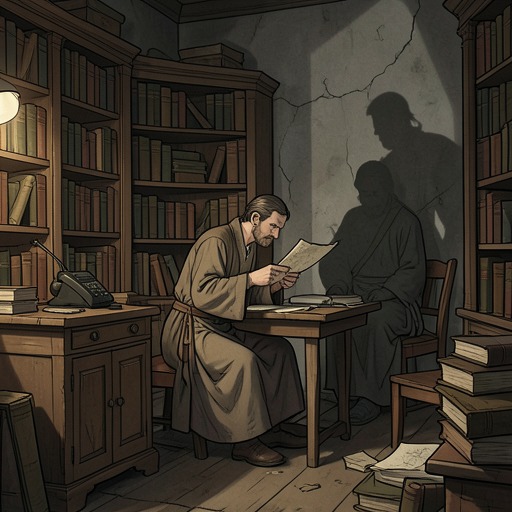
The Grafters, formally called the Wetenschappelijk Broederschap van Natuurkundigen, arose among alchemists working in the lands that would eventually form Belgium. Most of the early practitioners were described as minor figures pursuing experiments in poorly equipped settings, but the brotherhood also attracted wealthy noblemen. These sponsors supported the enterprise in hopes of gaining financial returns, providing the resources that allowed the alchemists to continue their work.
The decisive fact was that the experiments worked. The account does not describe the precise discoveries as a single fifteenth-century breakthrough, but presents the brotherhood’s successful processes as the foundation for its later ability to alter and augment bodies. What began as an investment in alchemy therefore acquired consequences beyond the sponsors’ original calculations: it gave the Grafters capabilities that could be turned toward power.
State affiliation and a sheltered research program
Rather than immediately using their new capabilities to seize control, the wealthy sponsors met with the ruler of the time. Their negotiations resulted in the brotherhood’s official affiliation with the government. The arrangement was described as civilized, though the political structure of the region was not yet highly organized. This early state connection gave the Grafters a protected basis for continuing their work.
For the next several centuries, they concentrated on their studies rather than trying to direct political affairs. The lands around them changed rulers and were divided more than once, but the Grafters retained their funding and kept refining their techniques. Their relative distance from political upheaval was partly due to the limited awareness of successive rulers and partly to the brotherhood’s own lack of interest in those developments. The result was an unusually long period in which its capabilities could develop without attracting sustained outside intervention.
The Checquy’s historical frame
The fifteenth-century origin of the Grafters sits within a broader account of the Checquy, an organization that had served Britain for centuries. Its loyalty was presented as loyalty to the country rather than to any particular ruler: it adapted to changing governments and treated its work as a secret national function. The contrast is important. The Grafters began as a government-affiliated research brotherhood in the lands that became Belgium; the Checquy understood itself as a continuing instrument of Britain, surviving shifts of power by changing how it served the state.
The Checquy’s later historical account also makes clear how little it initially thought of the Grafters. It was vaguely aware of them but did not consider them important, regarding their work as isolated experimentation rather than a strategic threat. That judgment would be overturned as the Grafters refined their methods into a military capacity. The fifteenth-century beginnings thus matter not only as an origin point, but as the start of the long interval in which the organization’s growing strength went largely unrecognized.
Institutional legacies
The Grafters’ early reliance on noble funding, government affiliation, and sustained research established a pattern that endured beyond the century in which the group arose. Their work was not simply an episode in the history of alchemy: it created the basis for later bodily modification and for the military threat the Checquy would eventually confront. The organization’s development shows how a political system can shelter a capability without fully anticipating what that capability will become.
The Checquy’s own account of recruitment and authority offers a further contrast between the institutions. It describes the organization as empowered to claim citizens with unusual abilities and to bind full members through oaths, contracts, and secrecy obligations. Set beside the Grafters’ beginning as a funded, officially affiliated brotherhood, that history places both groups within a shared problem: supernatural capacity is shaped not only by discovery, but by the institutions that finance, claim, conceal, or attempt to control it.